
Test yourselves to see if you are in the faith. Examine yourselves. Or do you yourselves not recognize that Jesus Christ is in you?—unless you fail the test.
2 Corinthians 13:5
“Then Moses recited aloud every single word of this song to the entire assembly of Israel.”
Deuteronomy 31:30
Baruch said to them, “At his dictation. He recited all these words to me while I was writing on the scroll in ink.”
Jeremiah 36:18
Catechism and recitation are processes of learning by heart, storing up knowledge in our hearts and minds. Narration, dictation, and copywork are closely related in that they shape the soul by means of imitating and contemplating great ideas.
Catechism Choices
Catechism is simply a series of questions with specific answers meant to be learned by heart. Typically, this is done in some Christian traditions for children or new converts to the faith as a means of learning basic Christian doctrine. This method can also be used to learn the grammar (basic facts) of any subject. A good example of this was the Logic of English curriculum, which made very effective and ample use of repeated Q&A to teach reading, spelling, and English grammar.
- 3/K – K/2nd, 5th/7th – 6th/8th: Ask Me Whoo–the Children’s First Catechism word for word set to music.
- 1st/3rd – 3rd/5th: Songs for Saplings–songs based on the Westminster Shorter Catechism with integrated supporting scripture.
- 6th/8th-7th/9th: Wesley’s Catechism. This is John Wesley’s take on the Westminster Shorter Catechism, revised to be a little less Calvinistic. I made my own adaption of the catechism and used it as copywork, along with key scriptures, as a means of memory and handwriting practice. My version is below.
Memory Work Choices
Classical memory work was important for us through the elementary years because it helped to define our focus for various areas of study, especially history and science. Both programs which we followed had weekly facts set to music in subjects such as hymns, scripture, English grammar, math, science, history, geography, Latin, and history timelines.
- 3/K – K/2nd: Classical Conversations Foundations Memory Work, Cycles 1-3 (for Kindergarten through 6th grade)
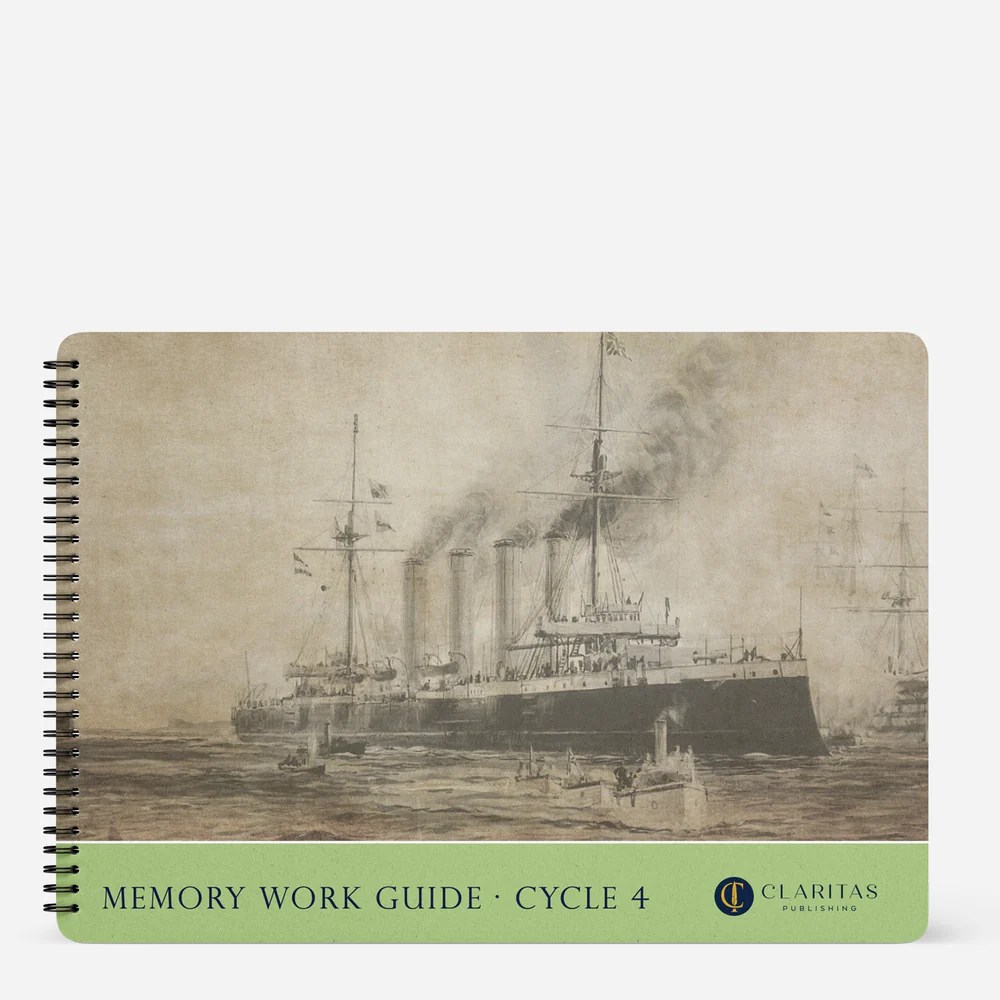
- 1st/3rd – 6th/7th: Claritas Classical Academy, Cycles 1-4 then repeating Cycles 1-2: Memory Work Guides, Map Booklets, and Cross Seven videos and quizzes online or via apps (for Kindergarten through 6th grades).
- Not used: Invictus Classical Press, which also makes cyclic memory guides for K-5, or MasterPoint, which make classical curriculum guides for the junior high and high school years..

 Wild West Schoolhouse